
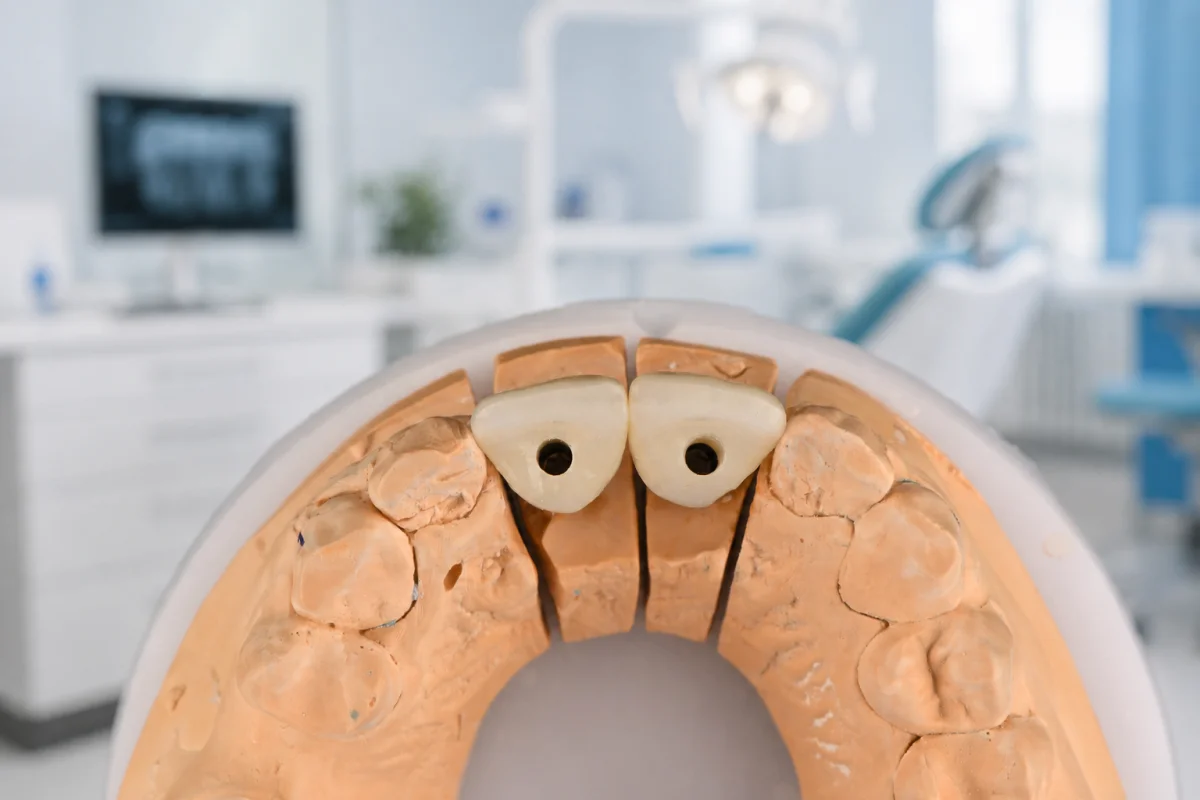
Ceramic veneers, metal-ceramic crowns, implant-supported crowns, implant-supported dentures, attachment-retained dentures.
Ceramic veneers
A major trend in modern dentistry is aesthetics, especially in the anterior (front) teeth region. Patients are increasingly demanding and often unsure how to solve problems related to tooth discoloration, shape, and position. Traditional methods have included tooth whitening, restorations with modern composite materials, and the fabrication of metal-ceramic crowns.
Ceramic veneers are the best aesthetic solution whenever it is possible to minimally invasively prepare the tooth, preserve as much healthy tooth structure as possible, and at the same time correct existing irregularities. In cases of more severe irregularities, stronger discoloration of non-vital teeth, large existing composite fillings that need to be removed during veneer preparation, or other contraindications, ceramic crowns are indicated instead. This means that more tooth structure is removed, but the aesthetic result remains similar, as both solutions are made from the same high-quality ceramic materials.
In the posterior region, ceramic crowns are also indicated rather than veneers, taking into account occlusion and masticatory function, which are prioritized in this case. The choice of ceramic system depends on multiple factors and is made by the dentist in consultation with the dental technician. Metal-free ceramics are increasingly becoming the leading material in aesthetic dentistry, associated with natural, beautiful, and perfect results.
Metal-ceramic crowns
Metal-ceramic crowns are most commonly indicated for the reconstruction of treated teeth and the replacement of the remaining crown structure, as well as for replacing missing teeth using metal-ceramic bridges. They represent the long-standing gold standard in conventional prosthodontics.
Implant-supported crowns
The most common question we receive from patients is whether to choose a bridge or an implant-supported crown.
We generally recommend implant placement whenever a single tooth is missing, favoring an implant-supported crown over the preparation (grinding) of two adjacent healthy teeth to replace a single missing tooth.
Implant-supported dentures
Complete dentures are nowadays often retained using so-called locators on implants, which represent an ideal solution for patients with significant alveolar ridge resorption, where it is almost impossible to fabricate a stable and well-retained denture.
In the upper jaw, a minimum of 4 implants is typically required to support a complete denture, while in the lower jaw it is possible to achieve good results even with 2 implants. This approach provides excellent retention and stabilization of complete dentures. It is very important to note that such patients are required to attend follow-up examinations every 6 months, and the need for adjustments is minimal.
Attachment-retained dentures
Whenever there are a certain number of remaining teeth that need to be restored, while posterior teeth are missing, a combined prosthetic solution using crowns and attachment-retained dentures is indicated.
Attachments (often called “drikers”) are retention and stabilization elements of a partial removable (skeleton) denture. Dentures designed in this way provide significantly greater comfort for the patient compared to conventional ones, as they have reduced mobility, no visible clasps, and—most importantly—the patient has the feeling of wearing a fixed prosthetic solution rather than a removable one.
The denture is attached to metal-ceramic crowns, and the entire restoration provides satisfactory aesthetic and functional results.